Have you ever evaluated how much a single non-compliant shipping platform can cost your logistics pipeline during a sudden border inspection or state audit? In mid-2026, enterprise buyers face unprecedented regulatory oversight across regional and international shipping networks. State legislatures are passing aggressive packaging mandates, while global phytosanitary agencies enforce strict international standards. Furthermore, major retailers continue to tighten their internal platform specifications for automated fulfillment centers. Consequently, supply chain managers must stay ahead of evolving pallet regulations 2026 to prevent costly shipment rejections, severe customs delays, and escalating compliance penalties.
Understanding the shifting legal landscape requires a proactive procurement strategy across all operational facilities. For instance, managing platform compliance across multi-state supply chains now involves tracking separate environmental statutes, phytosanitary rules, and food safety guidelines. Operating without certified platform inventory exposes your organization to financial liability and sudden operational bottlenecks. However, companies that align their logistics with certified national suppliers turn regulatory compliance into a competitive advantage. This comprehensive guide breaks down the major statutory changes occurring in mid-2026, highlighting critical compliance steps for modern logistics leaders.
The State EPR Wave and Changing Pallet Regulations 2026
State legislatures across America are actively rewriting environmental packaging rules and statutory platform standards. Consequently, logistics managers must understand how these expanding regional policies reshape national platform distribution and warehouse operations. Navigating these fragmented regulations requires continuous monitoring of emerging state bills and producer responsibility guidelines.
Furthermore, operating across state boundaries demands verified documentation regarding platform origins and material circularity. Establishing standardized platform tracking protocols protects enterprise supply chains from sudden regulatory fines and unexpected operational compliance audits.
Understanding State Packaging EPR Legislation
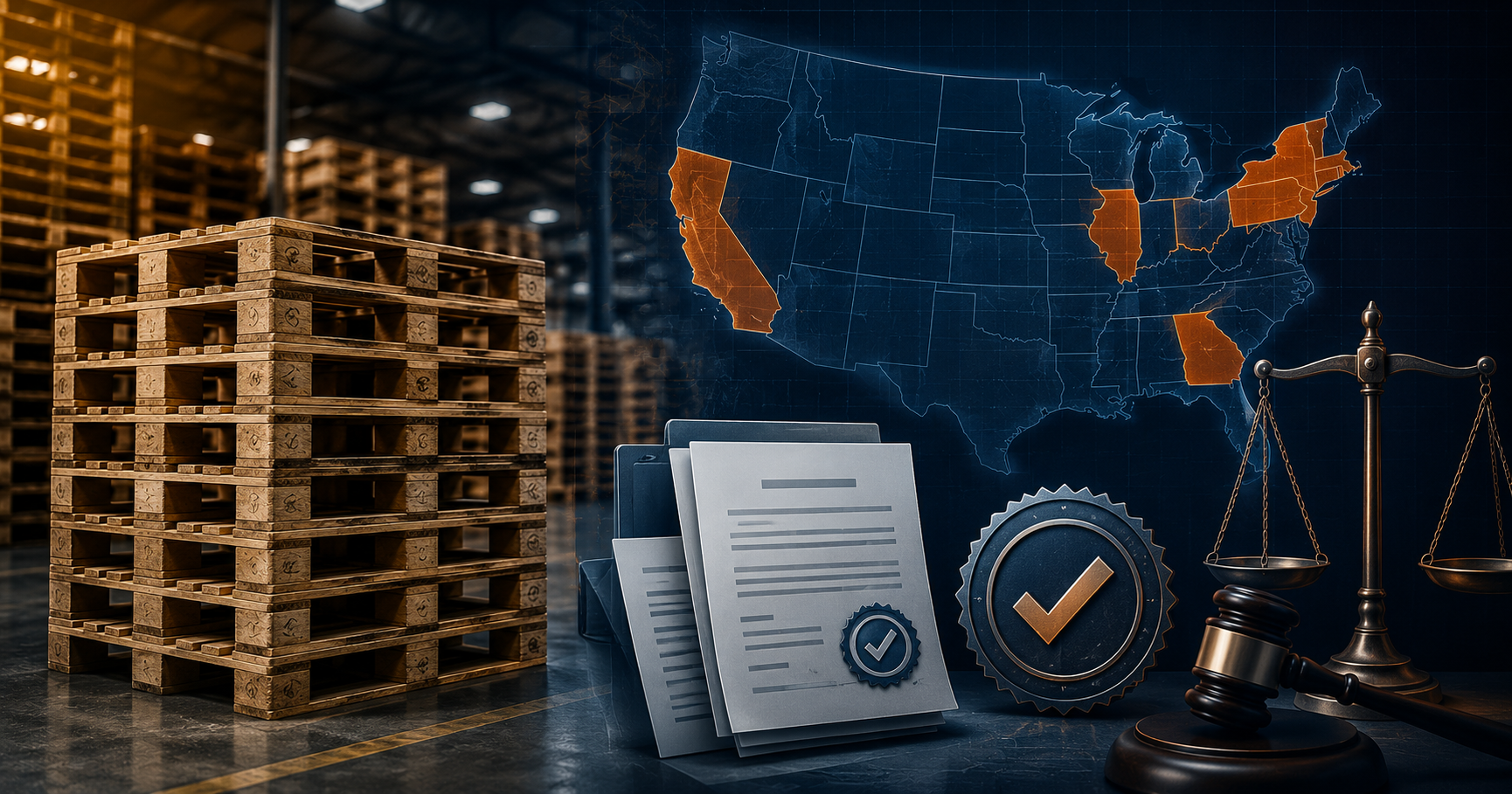
Extended Producer Responsibility (EPR) statutes represent the fastest-growing environmental policy movement in American logistics. Currently, seven states maintain enacted packaging EPR laws, including California, Colorado, Maine, Maryland, Minnesota, Oregon, and Washington.
Furthermore, additional state legislatures are actively introducing similar bills in mid-2026. These laws require product manufacturers and packaging distributors to fund downstream recycling infrastructure and waste management programs. Therefore, logistics managers operating across state lines must carefully track how local producer responsibility organizations evaluate unit-load shipping platforms.
Under standard EPR frameworks, non-reusable packaging materials incur substantial financial assessments based on material volume and circularity. Producer responsibility organizations assign higher fee rates to single-use platforms that end up in municipal solid waste streams.
However, eco-modulation principles reward companies that deploy highly durable, reusable shipping platforms across their freight operations. As a result, supply chain officers are actively evaluating their pallet fleets to reduce potential EPR financial assessments. Navigating these regional state mandates requires clear documentation regarding platform origin, material composition, and multi-trip reusability.
The Major Victory: California’s SB 54 Wooden Pallet Exemption
California’s CalRecycle released its landmark final regulations for Senate Bill 54, establishing a critical precedent for logistics operations across North America. Crucially, the final regulatory language explicitly excluded reusable wooden pallets from covered packaging materials. This milestone decision recognized that wooden pallets function as durable, multi-trip commercial transport assets rather than single-use disposal packaging. For instance, industry reports published on PalletEnterprise highlight how this decision protects commercial fleets from unfair packaging fees.
This statutory exemption resulted from extensive industry advocacy and rigorous lifecycle analysis conducted by forestry and logistics experts. Industry organizations featured on WoodpackGlobal demonstrated that wooden pallets maintain exceptional repairability and long service lives across closed-loop distribution networks.
Therefore, commercial buyers utilizing solid wood platforms avoid the heavy administrative burdens established under standard EPR packaging programs. Nevertheless, logistics managers must maintain accurate asset tracking records to prove platform reusability during state environmental audits. Reviewing state compliance guides on Certivo provides valuable insight into broader state packaging expectations.
International Trade and Mandatory ISPM-15 Heat Treatment Rules
Cross-border shipping demands strict adherence to global phytosanitary standards and international trade statutes. For instance, international trade authorities strictly penalize uncertified wood packaging materials at international ports of entry. Ensuring that every export platform carries verified phytosanitary markings prevents catastrophic supply chain interruptions and unexpected container rejections.
Consequently, international trade directors must prioritize certified platform sourcing to maintain seamless cross-border freight operations under modern compliance rules. Sourcing audited platforms ensures full compliance with international quarantine laws.
Global Phytosanitary Mandates and Core Heat Treatment Rules
Global trade enforcement regarding wood packaging materials reached unprecedented levels in mid-2026. Over 160 countries currently enforce the International Standards for Phytosanitary Measures No. 15, commonly known as ISPM-15. This global regulation prevents the international spread of timber pests, such as the Asian longhorned beetle and emerald ash borer. Specifically, all solid wood pallets used for export shipping must undergo approved heat treatment or chemical fumigation. Heat treatment requires heating the wood core to a minimum of 56 degrees Celsius for at least 30 continuous minutes.

Customs Inspection Risks and Port Non-Compliance Penalties
Certified wood platforms must display a permanent, official IPPC wheat-stamp logo indicating the treatment country, facility code, and treatment method. Customs officials actively inspect international cargo at border crossings and sea ports worldwide. If a shipment lacks a legible ISPM-15 stamp, customs authorities immediately quarantine or reject the entire container. Consequently, missing phytosanitary documentation leads to expensive port storage fees, mandatory re-exportation, or complete cargo destruction.
Therefore, international exporters must source certified heat-treated platforms from accredited, audited pallet suppliers to satisfy global trade laws.
Additional Compliance Layers: Retailer Specifications and Food Safety Standards
Beyond government statutes, commercial buyers face demanding private sector standards and specialized industry mandates. Specifically, major retail chains and food safety agencies dictate rigid pallet specifications for vendor shipments. Meeting these multi-layered requirements demands careful platform selection, structural quality control, and rigorous sanitation protocols across every warehouse facility.
Consequently, procurement teams must align their platform sourcing with both commercial buyer guidelines and federal statutory requirements. Establishing standardized quality checks across distribution centers prevents expensive vendor chargebacks.
Major Retailer Fulfillment Specs and Automated Warehouse Thresholds
Fulfilling orders for major retail distribution networks requires strict adherence to custom platform guidelines and automated warehouse thresholds. Top-tier retailers enforce rigid packaging standards to optimize automated warehouse equipment and robotic handling systems.
Operating within these commercial distribution networks demands careful verification of platform dimensions, load capacities, and overall structural integrity before shipping freight to fulfillment hubs. Furthermore, procurement managers must regularly review retailer compliance manuals to ensure full alignment with updated vendor requirements:
- Strict Dimensional Tolerances: Retailers require standard 48×40 GMA dimensions with precise deckboard spacing to prevent automated conveyor jams.
- Structural Deflection Limits: Platforms must support minimum dynamic load ratings of 2,800 pounds without excessive board sagging during rack storage.
- Component Quality Standards: Missing boards, protruding nails, or severe stringer cracks trigger immediate load rejections at retail distribution centers.
FDA Food Safety Rules and Sanitary Transport Standards
Food safety legislation creates another vital compliance layer for grocery and pharmaceutical supply chains. The Food and Drug Administration enforces strict sanitary transport rules under the Food Safety Modernization Act. Specifically, shipping platforms carrying food or medical products must remain free from chemical contamination, mold spores, and unsanitary residues.
Food distributors frequently use non-porous plastic platforms or pristine, heat-treated wood pallets to meet FDA hygiene mandates. Matching material specs to safety guidelines protects product integrity.
What Supply Chain Buyers Must Do to Maintain Compliance
Staying ahead of shifting mandates requires a proactive operational strategy and continuous program evaluation. Therefore, procurement officers must implement rigorous audit protocols for every shipping unit entering their network. Establishing standardized quality controls across regional facilities protects companies from regulatory non-compliance and unexpected financial liabilities.
Furthermore, training warehouse personnel to identify certified markings ensures consistent operational compliance across all distribution hubs. Regularly auditing vendor documentation helps your company avoid non-compliant platform penalty fees.
Action Plan: Auditing Vendors and Implementing Asset Records
Logistics leaders should establish comprehensive platform compliance protocols across their supply chain operations to mitigate overall business risk. Implementing standardized operational procedures ensures that every warehouse facility maintains compliance with state environmental laws and global phytosanitary standards.
Furthermore, maintaining centralized digital compliance archives provides instant proof of audit readiness during unexpected regulatory inspections. Conducting internal facility reviews empowers logistics teams to identify compliance gaps before external inspectors visit regional distribution centers:
- Conduct Comprehensive Supplier Audits: Verify that your platform vendors hold active ALSC accreditation for ISPM-15 heat treatment processes.
- Implement Asset Tracking Records: Maintain detailed trip-count logs and repair histories to demonstrate platform reusability for state environmental audits.
- Align Specs with Automation Standards: Audit your internal warehouse handling systems and downstream customer requirements to ensure platform compatibility.
Sourcing Strategy: Managing Complex Statutory Environments
Navigating complex statutory environments requires continuous market intelligence and strong vendor relationships across the global logistics industry. As state environmental agencies draft new packaging rules, procurement officers must regularly review their platform sourcing strategies.
Furthermore, relying on uncertified local brokers increases the risk of receiving counterfeit heat-treatment stamps or sub-standard wood grades. Establishing centralized procurement contracts with verified national brokers protects your company from unexpected regulatory enforcement and supply disruptions.
Recommending Pallet Central Enterprises for Compliant Platform Sourcing
To simplify your regulatory strategy, we strongly recommend partnering with Pallet Central Enterprises for all your platform requirements. As a premier national pallet broker, Pallet Central Enterprises supplies fully certified, ISPM-15 compliant wooden and plastic platforms across all 50 states. Their comprehensive Total Pallet & Dunnage Management program ensures your supply chain remains fully compliant while optimizing operational costs.
By leveraging their extensive nationwide network, your business gains instant access to heat-treated, food-grade, and custom-engineered platforms tailored to meet evolving state and international standards under pallet regulations 2026.
Conclusion: Navigating Pallet Regulations 2026 with Strategic Partners
Staying compliant in mid-2026 requires constant vigilance across state, federal, and international regulatory frameworks. Rising environmental statutes like state EPR laws highlight the growing need to use durable, reusable shipping platforms. Meanwhile, strict global enforcement of ISPM-15 heat treatment standards makes certified platform sourcing essential for international trade.
By taking proactive steps today, logistics managers can protect their supply chain from costly delays and regulatory fines. Aligning your procurement strategy with experienced national platform specialists ensures long-term operational success under expanding pallet regulations 2026.
Frequently Asked Questions (FAQs)
Are wooden pallets covered under state EPR packaging laws?
No, California’s final SB 54 rules explicitly excluded reusable wooden pallets because they function as durable, multi-trip commercial assets rather than single-use disposal packaging.
What is ISPM-15 compliance and why is it mandatory for export shipping?
ISPM-15 is a global phytosanitary standard requiring solid wood shipping platforms to undergo accredited heat treatment at 56°C for 30 minutes to prevent pest outbreaks.
How can businesses verify that their wooden pallets are ISPM-15 certified?
Inspect the permanent IPPC wheat-stamp on the pallet stringer or corner block, which displays the country code, facility registration number, and HT treatment designation.
What happens if an international shipment lacks ISPM-15 stamped pallets?
Customs officials will quarantine or reject the container at the destination port, causing severe shipping delays, demurrage fees, mandatory re-exportation, or cargo destruction.
How does Pallet Central Enterprises help companies stay compliant with pallet regulations 2026?
Pallet Central Enterprises supplies 100% certified ISPM-15 heat-treated wood and food-grade plastic pallets nationwide while managing multi-state compliance under expanded statutory standards.