Have you ever questioned which type of pallet is more sensible in your supply chain setting where costs are increasing, and sustainability demands are growing? The question of plastic vs wooden pallets has never been more crucial in 2026, particularly as companies strike a balance among performance, budget, and environmental responsibility.
The two types of pallets are of significant importance to contemporary logistics. Nevertheless, evolving policies, increased supply routes, and green agenda goals have compelled firms to reevaluate conventional decisions. This comparison breaks down the cost, durability, environmental, performance, and on-road performance so you can choose what best suits your operation.
Understanding the Core Differences Between Plastic and Wooden Pallets
It is worth understanding how these pallets differ at a fundamental level before comparing costs or sustainability. The Plastic vs Wooden Pallets debate begins with materials, construction, and its intended use.
Material Composition and Construction
Wooden pallets are generally constructed using softwood or hardwood boards, which are nailed together. Plastic pallets are made of recycled or virgin polymers and therefore have homogenous designs with similar dimensions.
Due to these construction differences, the behavior of each pallet under stress, exposure to moisture, and repeated handling varies.
Intended Use Cases
Wooden pallets are usually applicable in short-term, one-way shipments where economy is critical. Plastic pallets are also tailored to closed-circuit long-term box solutions where dependability and reliability are more crucial than initial cost.
Cost Comparison: Plastic vs Wooden Pallets in 2026
When comparing plastic vs wooden pallets, the first question that most buyers will ask is cost. Nonetheless, when the purchase price is used as the sole basis for long-term decisions, it can lead to poor choices.
Upfront Purchase Costs
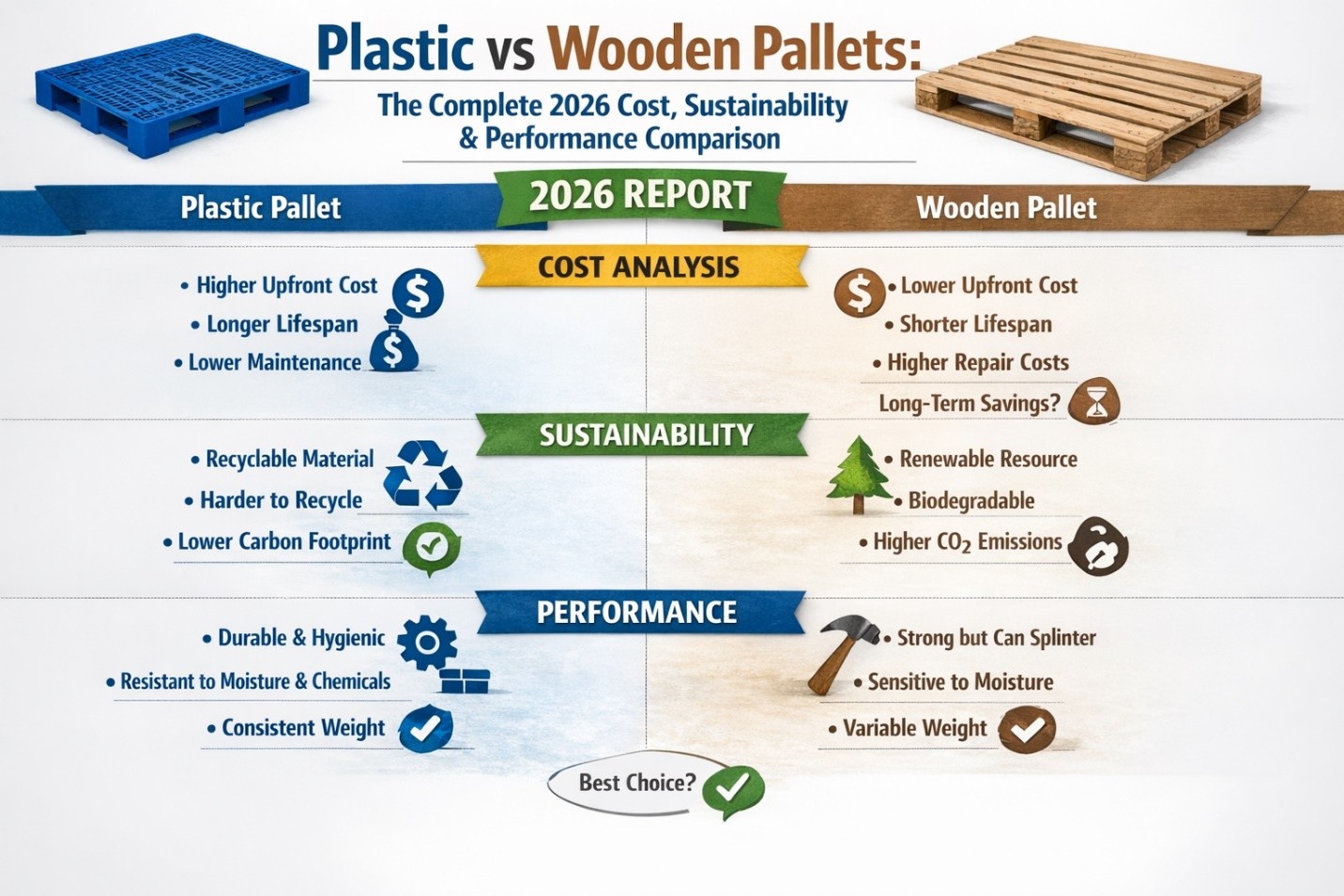
Wooden pallets are generally cheaper. This makes them appealing to startups, seasonal activities, or limited shipping applications. Plastic pallets cost more to buy initially than wood pallets, which is a constraint for some businesses.
Nevertheless, the original cost is not the true cost of ownership.
Long-Term Lifecycle Costs
Plastic pallets are more long-lasting than wooden pallets. They are resistant to moisture, insects, and structural decay. Thus, the frequency of replacement decreases.
Wooden pallets need fixing and ultimate disposal. Whereas repair is easy, the hidden costs are labor and downtime. The plastic vs wooden pallets cost analysis usually favors plastic in the long term.
Performance and Durability in Real-World Logistics
Pallet consistency in performance is a significant factor in pallet selection, particularly in high-volume operations. The Plastic vs Wooden Pallets debate is better understood when the pallets are put in real-life conditions.
Load Capacity and Structural Strength
Wooden pallets perform well when carrying heavy loads, although their strength depends on the quality of the wood and its construction. In the long term, joints and boards can be weakened by constant use.
Plastic pallets offer a uniform load-carrying capacity. They are molded, giving them an even distribution of weight and minimizing the risk of failure during handling.
Resistance to Environmental Conditions
Pallet performance is affected by moisture, temperature changes, and chemicals. Wooden pallets are moisture-absorbing and can therefore warp or develop mold. Plastic pallets are resistant to humidity and most chemicals, hence they are used in sterile conditions.
Maintenance and Repair Considerations
Maintenance directly influences operational efficiency. In comparing plastic vs wooden pallets, maintenance requirements differ considerably.
Repair Flexibility
Wooden pallets can be easily repaired. Pallets have broken boards that are easily replaced, prolonging their life. But frequent repairs increase labor costs.
The plastic pallets require minimal maintenance. The majority of them are recycled rather than repaired when damaged. To most companies, less maintenance work compensates for fewer repairs.
Sustainability: Plastic vs Wooden Pallets in 2026
Sustainability is now a decision-driving factor and not an appendix. A sustainability comparison of plastic vs wooden pallets must take a lifecycle perspective.
Environmental Impact of Wooden Pallets
Wooden pallets are made from renewable materials and support repair and recycling initiatives. Nevertheless, deforestation and discarded pallet waste remain problematic.
Environmental Impact of Plastic Pallets
Recycled plastic in pallets also has a longer lifespan, thereby minimizing overall waste. Recycled in the right way, they contribute to the models of a circular economy. Thus, reuse and recycling infrastructure are instrumental in sustainability.
Hygiene and Compliance Requirements
Some businesses cannot afford to cut corners. In such situations, plastic vs wooden pallets is not an option; it is a viable choice.
Sanitation and Cleanability
Plastic pallets are resistant to bacteria, moisture, and chemical absorption. They are easy to clean and satisfy food and pharmaceutical requirements. Wood pallets trap liquids and can contain contaminants, which restricts their application in controlled settings.
Export and International Shipping Factors
International shipping introduces additional factors to consider in the Plastic vs Wooden Pallets debate.
Export pallets made of wood can also be heat-treated to comply with international standards. This increases cost and processing time. Plastic pallets have none of such requirements and, therefore, are easily transportable internationally. With the increased global trade, ease of compliance is a welcome benefit.
Environmental Impact and Sustainability in 2026
Sustainability is no longer a marginal debate. In 2026, it will be the center of the Plastic vs Wooden Pallets decision for most organizations. Consumers are no longer interested in labels on materials but in the lifecycle impact of materials.
Carbon Footprint and Resource Use
Wooden pallets indicate a reliance on forestry, which can be replenished when used sustainably. The logging, transportation, and disposal, however, continue to be sources of emissions. Recycled plastics are used in pallets, so they do not have to be replaced as frequently. Hence, greater manufacturing emissions are offset by their extended lifespan.
Sustainability is determined by the usage patterns. One-way shipments favor wood. Plastic is more likely to be used in closed-loop systems.
Recycling and End-of-Life Options
Wooden pallets can be recycled or reused. Many end up as mulch or fuel. With the right recycling programs, plastic pallets are reintroduced into the production cycle. The plastic pallets have continued to bridge the sustainability gap as recycling infrastructure is enhanced.
Industry-Specific Use Cases
Not all operations encounter the same challenges. The decision between plastic and wooden pallets depends on the industry.
Retail and Distribution
Wooden pallets are frequently used in retailers handling mixed goods to be flexible and to control costs. Nonetheless, plastic pallets are gaining popularity in automated distribution centers due to their standardized size and strength.
Food, Beverage, and Pharmaceuticals
Plastic pallets are the best because they meet hygiene requirements. Their contamination resistance and ease of cleaning aid in their compliance and lower the risk.
Manufacturing and Heavy Industry
Heavy loads and special-sized pallets continue to use wooden pallets. Nevertheless, plastic pallets are becoming increasingly common in intra-transport loops where lifespan is more important than the initial investment.
Decision Framework: Which Pallet Is Right for You?
Businesses have to question what kind of pallet works best in their operation, rather than what kind of pallet is better in general. The decision between plastic and wooden pallets is easier to understand in a strategic context.
Key Questions to Ask
- Is the pallet used once or reused multiple times?
- Are hygiene or regulatory standards involved?
- Does automation require consistent pallet dimensions?
Answering these questions quickly narrows the choice.
Cost vs Value Perspective
Upfront price favors wood. Plastic is more likely to be favored in the long term. Thus, plastic pallets tend to be favored by businesses that are oriented toward sustainability, automation, and asset recovery.
How Pallet Central Enterprises Supports Smarter Pallet Choices
The Plastic vs Wooden Pallets decision is one where assumptions cannot guide you; instead, real-life experience would. Pallet Central Enterprises assists companies in assessing pallet performance, lifecycle value, and sustainability performance.
Pallet Central Enterprises promotes industry activities by providing wooden, plastic, and hybrid pallets. The custom pallet designs and their recycling programs help companies reduce waste without sacrificing performance.
The Future Outlook for Pallet Materials
The debate on plastic vs wooden pallets is still being transformed by material innovation. Recycled composite, lightweight design, and hybrid pallet are the new trends. These solutions are geared toward integrating power, sustainability, and cost efficiency.
Pallet selection will be more strategic amid tightening regulations and increased automation. Companies that adapt early achieve long-term operational benefits.
Conclusion
The Plastic vs Wooden Pallets 2026 comparison is no longer about no longer about costs. It is a balance between performance, sustainability, compliance, and long-term value. Wooden pallets are flexible and inexpensive, whereas plastic pallets are consistent, hygienic, and durable. The correct option is based on the pallet flow within your supply chain. By relying on the professional advice of partners, such as Pallet Central Enterprises, companies can make pallet-related choices that enable them to be efficient and sustainable.
FAQs
1. Which is cheaper: plastic or wooden pallets?
Wooden pallets cost less upfront, but plastic pallets often cost less over time due to a longer lifespan.
2. Are plastic pallets more sustainable than wooden pallets?
Sustainability depends on reuse and recycling. Plastic pallets perform well in closed-loop systems, while wooden pallets are better suited to short-term use.
3. Do plastic pallets work better with automation?
Yes. Their consistent size and strength support automated handling systems.
4. Are wooden pallets still used in 2026?
Absolutely. They remain widely used, especially for heavy loads and one-way shipments.
5. How can Pallet Central Enterprises help choose the right pallet?
They assess operational needs, cost goals, and sustainability targets to recommend the best pallet solution.