Did you ever consider how much the world’s supply chain relies on something as basic as a pallet? The Pallet Industry in 2026 is at a turning point as trade volumes and the complexity of logistics networks are increasing, taking a toll on how goods are transferred across the globe.
Pallet manufacturers and users are under pressure to re-examine old systems due to rising costs, sustainability pressures, automation, and changing trade policies. Simultaneously, new materials, intelligent technology, and closed cycles are bringing new opportunities. It is no longer a choice on where the industry is moving. It’s a competitive advantage.
The Current State of the Pallet Industry Heading Into 2026
The Pallet Industry in 2026 is a very different picture from what it was 5 years ago. The company is still experiencing increasing demand amid the rise of e-commerce, food distribution, and manufacturing worldwide. The supply chains, however, are no longer content with providing simple load support.
The market is still dominated by wooden pallets. Nevertheless, plastic and composite pallets are gaining popularity due to their durability and hygiene. Meanwhile, pallet recycling and reuse activities are no longer considered as optional practices.
Across the pallet supply chain, there have been labor shortages, volatility of the raw materials, and transportation disruptions. Thus, manufacturers are moving on to efficiency-based production studies and pallet lifecycle planning.
Key Market Trends Shaping the Pallet Industry in 2026
Innovation and sustainability are the most visible transformations in the Pallet Industry in 2026. Pallets are no longer considered renewable resources; businesses now see them as a strategic asset.
Smart pallets and connected logistics
RFID and IoT sensors are installed on smart pallets, which are increasingly popular. Such pallets enhance tracking and loss reduction, as well as provide real-time inventory visibility. Consequently, the companies will have more control over the logistics performance and asset recovery.
Sustainability-driven design choices
Pallet decisions are still influenced by environmental pressure. Most companies are now more inclined to reusable pallets, recycled materials, and closed-loop systems. As a result, trends in sustainable pallet production are affecting the buying decisions of various industries.
Automation in pallet manufacturing
Automation is no longer a vision thing. It’s a necessity. Robotics and AI-based systems help manufacturers respond to demand, even amid labor shortages. Thus, production lines are getting quicker, safer, and more consistent.
Material Shifts Across the Global Pallet Market
The Pallet Industry in 2026 has material selection as one of its main features. All of them involve trade-offs that enterprises must consider.
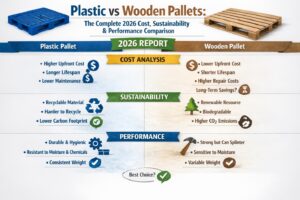
Wood pallets are still in use because of their low initial price and accessibility. Nevertheless, fluctuations in lumber prices still affect profitability. Plastic pallets, however, are durable and predictable but are more expensive.
There is an emergence of composite pallets as an intermediate. They are durable, lighter, and longer-lasting. With this trend intensifying, heat-treated wooden pallets, as well as plastic options, are becoming increasingly popular in global trade.
Risks Facing the Pallet Industry in 2026
Despite such growth potential, the Pallet Industry in 2026 faces actual risks that cannot be overlooked. Such risks impact distributors, manufacturers, and end users.
Supply chain disruptions
Disruptions in global logistics are unpredictable. Delays in shipping, high fuel prices, and political unrest may easily affect pallet availability and price. Hence, the business is diversifying suppliers and expanding production at the regional level.
Regulatory pressure and compliance
Export, phytosanitary, and recycling policies are constantly evolving. Failure to comply may result in fines, delays, or shipment rejection. This means pallet manufacturers must stay in line with shifting regulations.
Rising operational costs
The costs of labor, energy, and raw materials have increased. Margins decrease rapidly unless processes are optimized. Businesses are under this pressure to re-evaluate the design, sourcing, and reusability of pallets.
How Pallet Pooling and Circular Models Reduce Risk
The practice of circular economy is gaining momentum in the Pallet Industry in 2026. Pallet pooling and reuse schemes reduce waste and lower long-term costs.
Sharing pallet assets across networks reduces the need for new production, which is always required. In addition, closed-loop pallet programs enhance recovery rates and reduce losses. These systems can also be sustainable without compromising performance.
Pallet pooling models are particularly used for shipping routes of predictable retailers and manufacturers. Thus, it is still increasing in terms of its adoption in North America and Europe.
The Role of Pallet Central Enterprises in a Changing Market
The transformation of the Pallet Industry in 2026 demands that partners see the overall picture, both in terms of operational effectiveness and long-term positioning. This is the point where Pallet Central Enterprises is of paramount importance.
Pallet Central Enterprises aims to deliver custom-designed pallet solutions, implement recycling initiatives, and optimize the supply chain. Their strategy helps companies minimize waste, control costs, and maintain a steady supply of pallets of uniform quality. They facilitate the targets of efficiency and sustainability by providing reusable pallet systems and lifecycle management.
Opportunities Emerging in the Pallet Industry in 2026
In addition to addressing challenges, the Pallet Industry in 2026 also offers strong growth and innovation opportunities.
- Increased demand for smart pallets and tracking solutions
- Expansion of pallet recycling and refurbishment programs
- Growth in sustainable materials and lightweight designs
Companies that are ready to adapt are rewarded with these opportunities. Early investment in technology and sustainable practices builds long-term resilience.
Automation and Technology Reshaping the Pallet Industry in 2026
Automation is no longer a concept of the future. It is a contemporary fact that is defining the Pallet Industry in 2026. To satisfy demands, manufacturers now use robotics, automated nailing systems, and AI-powered quality checks. The tools help compensate for labor shortages and enhance uniformity.
There is also the emergence of smart pallets. Embedded sensors, RFID tags, and tracking software enable companies to track pallet movement in real time. Thus, losses are reduced, recovery is enhanced, and inventory information is more precise. This transformation facilitates expedited decision-making throughout logistics networks.
The use of technology, however, involves investment and training. Smaller manufacturers may also experience difficulties during the process. Nevertheless, achieving long-term efficiency and reliability gains is hard, and automation remains a niche.
Global Market Outlook for the Pallet Industry in 2026
The Pallet Industry in 2026 will continue to grow in global markets. Asia-Pacific is the region experiencing the most rapid growth due to manufacturing and export growth. The emphasis in North America and Europe is on pallet reuse, pooling, and sustainability enhancements.
Pallet demand arises from international trade, but the complexity of export regulations complicates it. Pallet design and sourcing decisions are influenced by heat-treatment requirements, material restrictions, and recycling requirements. Consequently, organizations have shown greater interest in having standard pallet systems capable of satisfying international compliance regulations.
The potential in emerging markets is high. Nevertheless, issues such as supply chain disruptions and exchange rate fluctuations remain. Companies that spread their sourcing and invest in flexible pallet systems are better positioned to cope with uncertainty.
Sustainability as a Competitive Advantage
Sustainability is no longer a branding game. It has a direct impact on contracts and partnerships as well as on long-term growth in the Pallet Industry in 2026. Retailers and manufacturers are setting expectations on suppliers to become waste-cutting and material-responsible.
The use of reusable pallets, recycled materials, and pallet repair programs will reduce environmental impact. Thus, in the long run, total pallet costs are reduced in companies with circular practices. Sustainability also supports compliance with emerging environmental laws.
This change opens up the room to innovation. Examples include lightweight pallets, composite materials, and smarter lifecycle tracking, all aspects of greener operations that do not compromise performance.
Strategic Opportunities for Pallet Buyers and Manufacturers
The Pallet Industry in 2026 rewards firms that think strategically rather than reactively. Firms that prefer treating pallets as assets rather than expenses have a superior ability to manage logistics costs.
Practical Strategies for Staying Competitive
- Invest in reusable and pooled pallet systems
- Partner with suppliers focused on lifecycle management
- Adopt technology that improves tracking and recovery
These steps reduce risk while improving long-term efficiency.
How Pallet Central Enterprises Supports Industry Evolution
It takes time and flexibility to sail through the Pallet Industry in 2026. Pallet Central Enterprises assists businesses in responding to industry changes through tailor-made pallet solutions, recycling programs, and supply chain services.
Pallet Central Enterprises helps companies minimize waste and manage costs better by reusing, repairing, or designing optimized pallets. Their solutions are consistent with the sustainability objective, but, quality-wise, they meet the performance criteria that modern logistics must ensure.
Preparing for the Next Phase of the Pallet Industry
The Pallet Industry 2026 is characterized by change. Firms that are slow to change risk being overtaken by market change. Those that invest in sustainability, technology, and smarter pallet control become more resilient.
Change will not slow down. Regulations, customer expectations, and logistics demands will keep changing. Thus, flexibility and forward planning will be needed.
Conclusion
The Pallet Industry in 2026 is at an intersection defined by innovation, sustainability, and global uncertainty. Although risks such as supply interruptions and rising prices persist, opportunities for automation, recycling, and smart pallet systems continue to expand. Companies that adopt these changes are well-positioned to succeed in the long term. With the right strategies and partners, such as Pallet Central Enterprises, companies can leverage industry headaches into a competitive edge.
FAQs
1. What is driving growth in the pallet industry in 2026?
E-commerce expansion, global trade, and increased demand for reusable pallet systems are key growth drivers.
2. Are wooden pallets still relevant in 2026?
Yes. Wooden pallets remain widely used, although recycling and repair programs are increasingly important.
3. How does sustainability impact the pallet industry?
Sustainability influences material choices, pallet reuse, and supplier selection across supply chains.
4. What risks does the pallet industry face in 2026?
Supply chain disruptions, regulatory changes, and rising production costs are major concerns.
5. How can Pallet Central Enterprises help businesses adapt?
Pallet Central Enterprises provides custom pallets, recycling programs, and lifecycle management solutions that support efficiency and sustainability.