Have you ever signed a pallet order only to find out that it was incapable of taking your load or even meeting the export specifications? These problems occur when custom pallet engineering specs are vague or incomplete.
Pallets might seem straightforward, but they are structural platforms that support the weight of thousands of pounds in complex supply chains. Pallets enhance safety, minimize damage, and improve efficiency when properly assembled. Specs, however, can conceal dangers when rushed or generic. This guide is a tutorial on how custom pallet engineering specs work and how to feel confident selecting the appropriate design as a buyer.
Why Custom Pallet Engineering Specs Matter More Than You Think
All the supply chains are different. Storage conditions vary. The ways of transportation vary. Product weights shift. Thus, a single standard pallet rarely suits all the operations.
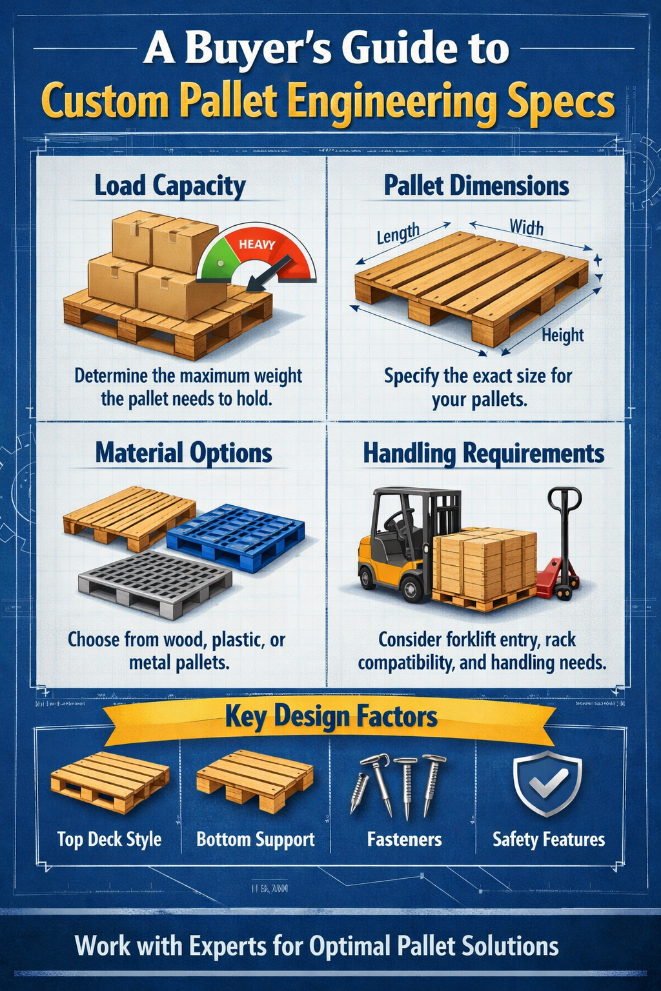
Custom pallet engineering specs specify the pallet’s performance requirements. These include load ratings, dimensions, deck layout, material type, compliance standards, and projected life. When these factors align with operational realities, pallets work reliably under pressure.
But failures occur when buyers do not use engineering data, but must make their judgments based on assumptions. Damage to products, rack collapses, and product rejections are among the consequences of inadequate specification planning. Clear engineering will help avoid those expensive errors.
Understanding Load Ratings: Static, Dynamic, and Racking
All custom pallet engineering specs still rely on load capacity. However, many buyers do not understand how load ratings work.
Static Load Capacity
The maximum weight a pallet can carry when resting on a hard surface is called the static load. As an example, a pallet stacked on the floor of a warehouse carries static weight. This rating is usually the highest because the weight is evenly distributed.
Dynamic Load Capacity
Dynamic load is the weight measured when the pallet is moving. Strain is initiated on the structure through forklift lifting, pallet jack movement, and transportation vibrations. Static ratings are thus lower compared to dynamic ratings.
Racking Load Capacity
Racking load is critical with beam racks used in warehouses. The pallet in this instance has two beams with no center support. The structure should not creep under the weight. The most frequently demanded requirement is racking capacity.
As the custom pallet engineering specs are reviewed, you must always specify which load rating corresponds to the operational combination you are used to. For industry testing standards, resources such as ASTM International can be very helpful.
Selecting the Right Materials for Performance and Cost
The choice of materials is a direct parameter affecting the strength, durability, and compliance. Hence, custom pallet engineering specs should clearly specify the material’s nature.
Common pallet materials include:
- Engineered wood pallets for consistent structural performance
- Hardwood for heavy-duty and impact-resistant applications
- Softwood for cost-effective transport pallets
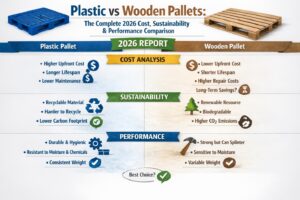
- Plastic for moisture-sensitive or hygienic environments
Predictable strength is found in engineered wood pallets because they are produced under controlled conditions. Hardwood is suitable for frequent heavy lifts. Plastic is effective in the food and pharmaceutical industries. The selection of materials must be evaluated in accordance with loads, environment, and reuse expectations.
Dimensions and Structural Design Considerations
The dimensions of pallets not only influence storage capacity but also affect shipping performance, handling compatibility, and load stability. That is why custom pallet engineering specs should specify precise dimensions.
Normal pallets can be used in most operations. Nonetheless, container space and freight costs can be minimized through custom pallet sizes that maximize space. For example, minor dimensional modifications could dramatically enhance the use of trailers.
The thickness and spacing of deck boards, as well as the structure, also influence performance. The more deck boards there are, the greater the support for smaller packages. Block pallets have four-way accessibility, delivering better forklift visibility. Stringer pallets cannot be entered without modifications.
Correct pallet design requirements ensure compatibility between the warehouse automation system and supply chain equipment.
Compliance and Regulatory Requirements
One cannot overlook export and industry policies. Custom pallet engineering specs should include compliance specifications to prevent shipment delays.
ISPM-15 for International Shipping
Export pallets made of wood must be heat-treated in accordance with ISPM-15. This eliminates cross-country transfer of pests. Lack of compliance may lead to shipment rejection or fines.
Pallet Testing and Verification
Testing should be done to verify engineering specs. Controlled performance testing also simulates real-life stresses and confirms load ratings. There are bodies such as the National Wooden Pallet and Container Association (NWPCA) that provide industry guidance regarding pallet performance standards. Compliance safeguards your supply chain against legal issues and financial losses.
Engineering for Heavy Loads and Industrial Applications
Certain industries operate in harsh conditions. Materials used in construction, components used in automobiles, and machine work demand tough support. Thus, custom pallet engineering specs must consider structural reinforcement early on.
Reinforcement Strategies for Heavy Loads
Heavy-load pallet engineering is often achieved by using thicker deck boards, stiffer stringers or blocks, and a larger fastener pattern. Higher-quality lumber or engineered parts might also be demanded.
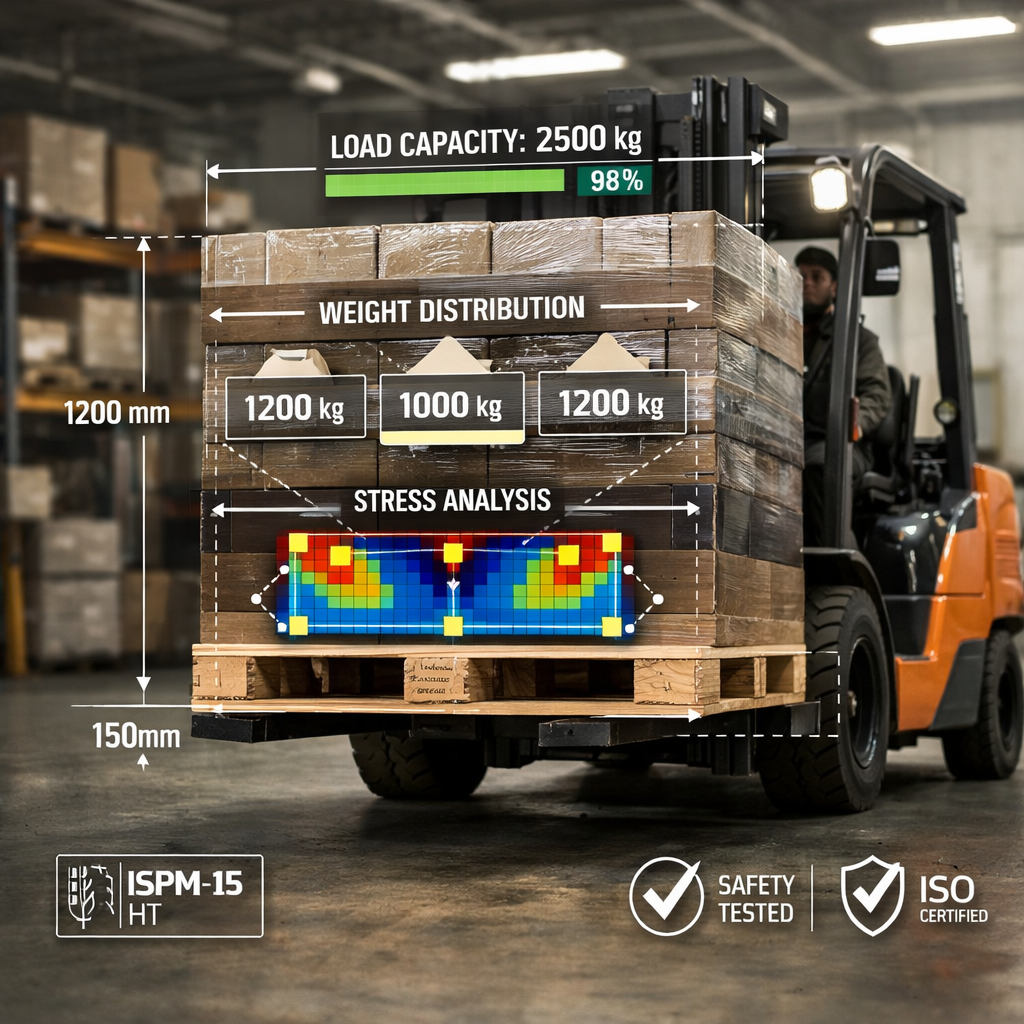
Load concentration is a significant factor. For example, small-contact-point machinery creates pressure zones. Pallets can crack or sag without reinforcement. Submission of precise weight-distribution information would ensure that engineering solutions match reality.
Designing for Supply Chain Efficiency
Strength alone is not enough. Efficiency also matters. Custom pallet engineering specs should be optimized for transportation, storage density, and automation compatibility.
Optimizing Dimensions for Freight Efficiency
Minor dimensional modification can enhance trailer utilization. Even a minor modification in the footprint can enable more units per shipment. These advantages significantly reduce freight costs in the long run.
Automation and Handling Compatibility
Tight dimensional tolerances are important if your warehouse is conveyor- or robotics-based. Incompatible pallets can interfere with automated systems. A combination of engineered pallet specifications eliminates these risks and improves flow.
Reusable vs Single-Use Pallet Design
Lifecycle planning is a factor that affects engineering decisions. Custom pallet engineering specs should identify either single or multi-use cycles.
Single-Use Design Considerations
Single-use pallets ensure cost efficiency. They give sufficient power to handle one shipment and are normally made of lighter-weight materials.
Engineering for Reusability
Reusable pallets need a more robust design. They are required to stand repeated lifting, stacking, and racking exposures. The investment may be costly in the short term, but it may be worth it in the long run.
Cost vs Performance: Finding the Right Balance
Purchasing is always affected by the budget. Nevertheless, the decrease in engineering quality may lead to larger bills in the future. Elaborately crafted custom pallet engineering specs guard against concealed operating expenses.
Disregard the price per pallet, assess lifecycle cost. Take into account reuse cycles, replacement frequency, and the risk of product damage. Enhanced engineered pallet requirements tend to lower the cost of the complete supply chain in the long term.
Why Working With an Engineering Partner Matters
The proper creation of custom pallet engineering specs requires technical analysis and field experience. The engineering choices should reflect the real conditions in warehouses and during transportation.
The Role of Pallet Central Enterprises
Pallet Central Enterprises is an organization focused on creating dedicated pallet engineering products that meet the needs of complex supply chains. Their department assesses load ratings, material selection, compliance obligations, and workflow efficiency before finalizing specifications.
By examining static, dynamic, and racking conditions, Pallet Central Enterprises ensures that engineered pallets perform reliably in practice.
A Practical Checklist Before Finalizing Custom Pallet Engineering Specs
Consider the following points before authorization of pallet production:
- Confirm static, dynamic, and racking load requirements
- Verify material grade and board thickness
- Check dimensional tolerances for automation compatibility
- Ensure ISPM-15 compliance for export shipments
- Validate design through performance testing
This checklist would align your custom pallet engineering specs with operational reality.
The Future of Engineered Pallet Specifications
Pallet engineering is still evolving as logistics systems become more sophisticated. The future of engineered pallets consists of data-driven design, more advanced testing techniques, and sustainable materials.
It is increasingly common to find lightweight engineered wood pallets that are much stronger. Currently, manufacturers use simulation software to predict performance after the production process. Thus, next-generation pallet engineering specifications will derive even further from quantifiable performance data.
Design is also affected by sustainability. Circular supply chains can be enhanced with reusable pallet systems and recyclable materials. In smart engineering, both environmental responsibility and structural reliability are combined.
Conclusion: Why Custom Pallet Engineering Specs Define Operational Success
The correct custom pallet engineering specs will secure your products, workers, and your bottom line. Everything is important in load ratings, material selection, compliance, and automation compatibility.
Specs are clear, and so are certain. They minimize risk, enhance effectiveness, and facilitate the sustainability of supply chain performance. The advantages of using a mature provider such as Pallet Central Enterprises are that your engineered pallet specifications won’t be based on theory but on the actual needs of the real world.
Engineering today helps avoid expensive tomorrow disruptions. This is why the cost of investing in well-designed custom pallet engineering specs is one of the best decisions that a buyer can make.
FAQs
1. What are Custom Pallet Engineering Specs?
They are detailed design requirements that define pallet dimensions, materials, load capacity, compliance standards, and structural configuration.
2. What is the difference between static and dynamic load capacity?
Static load refers to the weight supported while stationary. Dynamic load applies when the pallet is lifted or moved.
3. Why are racking load specifications important?
Racking load ratings ensure the pallet can safely span rack beams without bending or failure.
4. Do all pallets require ISPM-15 compliance?
Only wood pallets used for international shipping must meet ISPM-15 heat-treatment standards.
5. How can Pallet Central Enterprises help with custom pallet engineering?
They analyze your supply chain needs and design engineered pallet solutions that meet performance, compliance, and efficiency requirements.