Have you ever wondered why pallet shortages always come at the worst possible times, and excess pallets are not utilized at the slack times? That is precisely the issue that makes AI-Driven Pallet Demand Forecasting a necessity throughout the pallet and logistics industry.
Conventional forecasting techniques rely on past averages and manual estimates. But in 2026, supply chains are too fast to be guessed. Systems powered by AI process large volumes of information in real time, helping pallet manufacturers and distributors forecast demand with much greater accuracy. Consequently, companies eliminate shortages, minimize waste, and take production planning with confidence.
What Is AI-Driven Pallet Demand Forecasting?
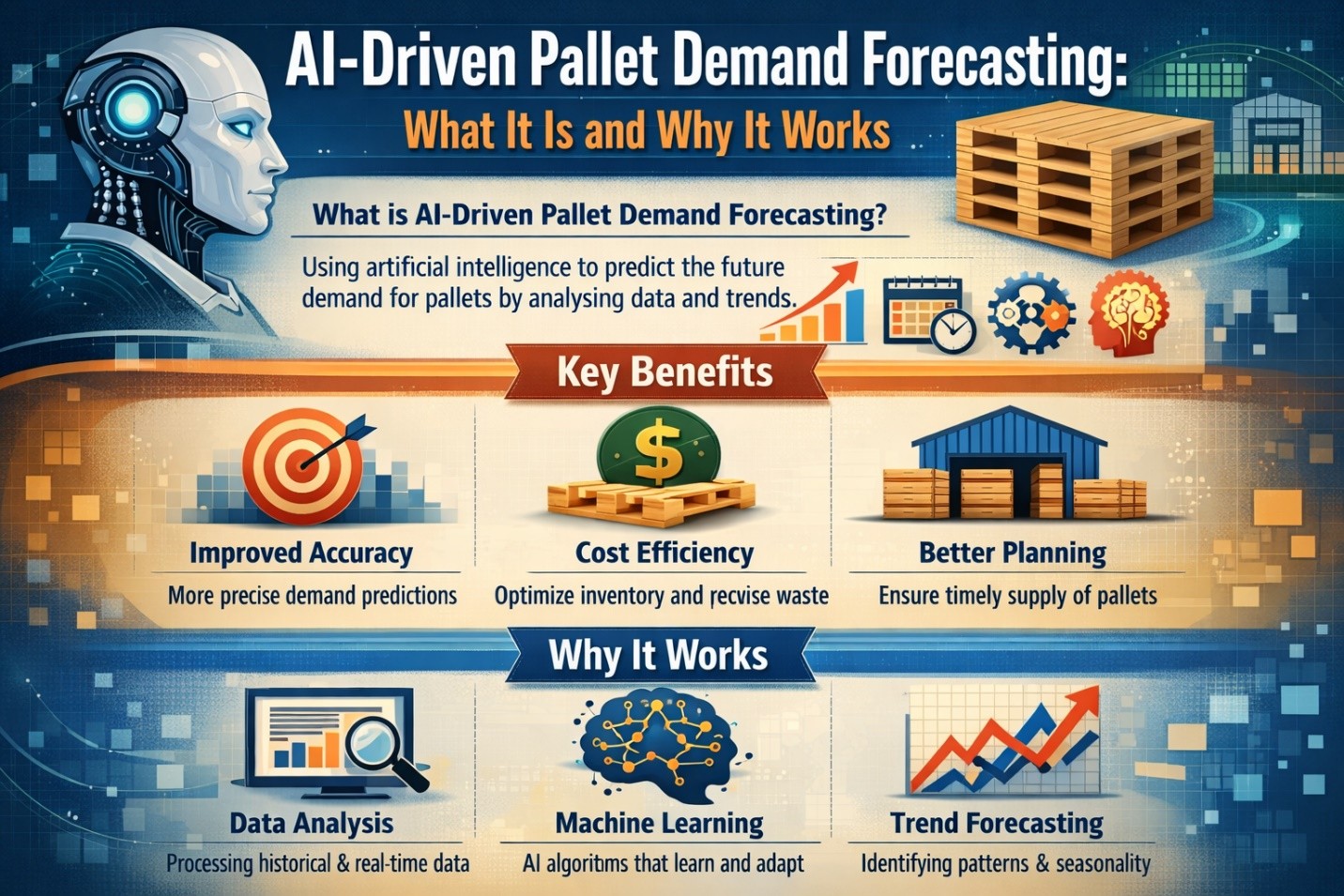
Fundamentally, AI-Driven Pallet Demand Forecasting is an approach that uses artificial intelligence and machine learning to predict future pallet demand based on patterns, trends, and real-time data. AI systems learn and improve constantly, unlike relying on spreadsheets or making fixed predictions.
How AI Forecasting Differs From Traditional Methods
The conventional way of forecasting pallet demand tends to be backward-looking. It is based on previous years’ figures and constant assumptions. AI-based predictions are prospective and built on real-time data, seasonal changes, customer dynamics, and the external environment.
Consequently, predictions adapt automatically to changes in conditions. Such versatility renders AI much more dependent on unstable markets.
Data Sources Used in AI Forecasting
AI models extract information from various sources. These entail past sales, consumer order trends, transportation volumes, and even economic indicators. When all these inputs are combined, AI-Driven Pallet Demand Forecasting will provide a more complete picture of future requirements.
Why Pallet Demand Forecasting Is So Challenging
The demand for pallets does not always follow a straight line. The spikes, regional disturbances, and seasonal variations are sudden, making them difficult to predict. This is one of the areas in which AI-Driven Pallet Demand Forecasting provides real value.
Seasonal and Industry-Specific Fluctuations
The demand for pallets can vary due to retail, harvest, and manufacturing cycles. These nuances are commonly absent in manual forecasting. Instead, AI systems identify recurring patterns and adjust forecasts.
Impact of Supply Chain Disruptions
The uncertainty is added to transportation delays, labor, and material shortages. AI solutions address these risks and enable firms to be proactive rather than reactive. Thus, pallet manufacturers can improve their capacity planning.
How AI-Driven Pallet Demand Forecasting Works
The concept of AI-Driven Pallet Demand Forecasting explains why AI is superior to traditional solutions.
Machine Learning and Pattern Recognition
Machine learning algorithms discover correlations among demand drivers. For example, they associate shifts in order volume with customer behavior or regional activity. Such systems also become more accurate with time as they acquire new information.
Real-Time Forecast Adjustments
AI models continuously update, unlike static forecasts. Forecast adjustments are made automatically when demand varies abruptly. Consequently, production teams remain in line with the real market requirements.
Benefits of AI-Driven Pallet Demand Forecasting
AI-Driven Pallet Demand Forecasting not only improves accuracy but also increases efficiency. They have a direct effect on cost control, efficiency, and customer satisfaction.
Reduced Pallet Shortages and Overstocking
Proper forecasting eliminates shortages and wastage at the end of the day. Thus, the firms maintain low inventory without unnecessary capital binding.
Improved Production Planning
The improved signals of demand make manufacturers more efficient in production. This saves on overtime, reduces waste, and enhances the use of equipment forecasting and Inventory Management.
AI Forecasting and Inventory Management
The accuracy of inventory is subject to the visibility of demand. AI-Driven Pallet Demand Forecasting enhances the inventory planning system by aligning supply with actual use.
Smarter Inventory Allocation
AI assists in allocating pallets to locations with the highest demand. Companies make decisions based on predictions rather than guesses. As a result, regional imbalances are reduced.
Lower Holding and Storage Costs
Storage costs are reduced when the inventory and demand are equal. This enhances general supply chain performance and cash flow.
How Pallet Central Enterprises Uses Data-Driven Forecasting
Experience is important as pallet demand gets more sophisticated. Pallet Central Enterprises assists customers in implementing data-driven planning for pallet supply strategies.
Through offering both operational-focused perspectives and predictive logistics, Pallet Central Enterprises assists companies in minimizing risk and enhancing availability. Their way of doing things supports smart production planning, recycling, and long pallets.
AI Forecasting Tools Transforming the Pallet Industry
The use of technology is gaining momentum across all areas of logistics, and AI-based Pallet Demand Forecasting is at the heart of this transformation. Current predictive solutions are embedded in ERP, WMS, and production planning systems, resulting in a single source of truth for demand signals.
Forecasting Software and Platforms
A variety of pallet manufacturers rely on AI-based systems that process historical demand data and real-time information. These systems simulate future cases, identify possible deficits, and propose production changes. Thus, the decision-makers receive clear information rather than assumptions.
Integration With Production and Logistics Systems
Forecasting tools are most effectively linked to manufacturing and logistics processes. AI systems automatically convert demand forecasts into production plans, inventory objectives, and transportation plans. This alignment minimizes delays and enhances on-time delivery performance.
Real-World Applications of AI-Driven Pallet Demand Forecasting
The usefulness of AI-Driven Pallet Demand Forecasting is evident in day-to-day operations. Companies with AI predictions experience rapid advances in accuracy and responsiveness.
Manufacturing Capacity Optimization
AI predictions help manufacturers match capacity to projected demand. Production teams are not responding to fluctuations in order levels; they arrange shifts and material purchases in advance. Consequently, overtime costs will be reduced while output remains steady.
Distribution and Regional Planning
Demand varies by region. Artificial intelligence models recognize geographic patterns and can forecast the most needed locations for pallets. Thus, companies are repositioning inventory on their own time rather than scrambling at the last minute to move pallets.
Reducing Risk Through Predictive Insights
Supply chain planning significantly involves risk management. The AI-based Pallet Demand Forecasting process helps businesses predict disruptions before they spiral out of control.
Early Warning Signals
AI systems identify the abnormalities of demand patterns. The patterns are continuously monitored, and planners are notified immediately when they fall short of expectations. This enables teams to explore reasons and re-evaluate plans at an early stage.
Scenario Planning and What-If Analysis
The forecasting tools model various demand scenarios. For example, they simulate the effects of seasonal peaks or supply limits. Consequently, companies have contingency plans in place rather than responding to pressure.
Challenges and Limitations of AI Forecasting
Although very strong, the AI-Driven Pallet Demand Forecasting has its issues. When limitations are understood, they result in realistic expectations.
Data Quality Matters
AI predictions rely on precise information. Lack of complete or outdated information reduces efficiency. Thus, companies should invest in clean data and regular reporting.
Human Oversight Remains Essential
AI facilitates decision-making, but not experience. Forecasts are still examined by skilled planners, taking operational judgement. The most impressive outcomes are the integration of human instinct and AI intelligence.
Strategic Advantages for Pallet Manufacturers and Suppliers
The competitive advantage of AI-Driven Pallet Demand Forecasting is constantly increasing. Businesses that use early benefits achieve long-term benefits.
Improved Customer Service
Proper forecasting improves order delivery and minimizes delays. Pallets are provided to customers on demand, which builds trust and customer relationships.
Better Financial Performance
Minimal waste, minimized storage expenses, and optimized production planning enhance margins. Thus, profitability is directly supported by forecasting accuracy.
How Pallet Central Enterprises Supports Forecast-Driven Planning
Experienced partners matter as forecasting becomes more advanced. Pallet Central Enterprises assists its customers in matching pallet supply strategies with data-driven demand plans.
Pallet Central Enterprises helps to make production scheduling smarter, implement recycling initiatives, and optimize inventory by leveraging operational knowledge and insights into future operations. Their strategy minimizes shortages without compromising supply chain flexibility.
The Future of AI-Driven Pallet Demand Forecasting
In the future, AI-Driven Pallet Demand Forecasting will continue to develop. Models will be used to incorporate broader data, such as market indicators and live logistics-generated data. With greater system accessibility, small and mid-sized manufacturers will also adopt them.
The accuracy in forecasting will no longer be a distinguishing factor. It will become a minimum condition of competition operations.
Conclusion
The AI-Driven Pallet Demand Forecasting is revolutionizing the planning, manufacturing, and asset allocation for pallet manufacturers and suppliers. When businesses substitute guesswork for predictive intelligence, they mitigate risk, increase efficiency, and fulfill customer demand with greater confidence. With the increased complexity of supply chains, AI-driven forecasting has become a necessity rather than a choice. One way companies can use data to develop resilient pallet supply networks is through their established partners, such as Pallet Central Enterprises.
FAQs
1. What is AI-driven pallet demand forecasting?
It applies artificial intelligence to forecast pallet demand using past and current data.
2. How does AI improve forecasting accuracy?
AI interprets trends, dynamically adjusts projections, and updates continuously based on new information.
3. Can small pallet manufacturers use AI forecasting?
Yes. A large variety of tools can be used in small and mid-sized operations.
4. Does AI forecasting replace human planners?
No. It assists human judgment by helping planners generate insights.
5. How does Pallet Central Enterprises help with demand forecasting?
They integrate data-driven planning with pallet supply strategies to minimize risk and enhance availability.